- Founded
- 1899
- Ownership
- Members' club, around 114,500 voters
- President
- Joan Laporta, re-elected March 2026
- Head coach
- Hansi Flick
- Stadium
- Spotify Camp Nou, club-owned
- 2024/25
- LaLiga champions
- 2025/26
- LaLiga champions
- Accounts to
- 30 June
Where the rebuild started
The summer of 2021 is usually told as a sporting story: the greatest player in the club's history leaving in tears because the contract could not be registered. It was a financial story first. Barcelona had spent the previous years signing players on fees and wages sized for a club that assumed its revenue would keep growing, and then the pandemic emptied the stadium. The 2020/21 accounts closed with a loss of €481m.
That alone would have been survivable for a club of Barcelona's size. What made it acute was the Spanish league's cost control system, which limits what each club may spend on its squad based on its own revenue and losses. A club deep in deficit sees its limit collapse — and a club above its limit cannot register new players at all.
The problem was not that Barcelona could not pay Messi. It was that LaLiga would not let it.
The rule that shaped everything
LaLiga sets each club a squad cost limit before the season. A club within it can spend freely. A club above it enters a restricted regime: for every euro it saves or earns, it may only reinvest a fraction in new players. Hence the shorthand of being "at 1:1" — the point at which a club is back within its limit and can spend one euro for every euro it frees up.
Everything Barcelona did from 2022 onwards is best read as a response to that rule. The club did not need money in the abstract. It needed income that would count, in that season, towards raising its limit.
The levers
The answer, announced in the summer of 2022, was a set of transactions the club itself called levers. Each sold a share of a future revenue stream in exchange for cash now.
What was sold, and what it bought
Each sold a share of a future revenue stream in exchange for cash now.
What was sold
What it bought
The accounting logic is the same one described in the piece on transfers. Sell an asset carried at close to zero and almost the whole price becomes a gain. A 25-year slice of television income has no book value, so selling it produced a large profit in a single year — while the cost, a quarter of that income forgone every season, is spread across the next 25.
That is the core of any honest assessment. The levers were not fraudulent, and they were not free. They moved income from the future to the present, and they did so at a price that the current board, the next one and probably the one after will all be paying.
They also had limits. Not every lever delivered what was announced: Libero, which had committed €40m for 10% of the club's digital offshoot Barça Vision, never paid, leaving the club to reverse the gain and go to court. And the VIP seats deal, signed in the last days of 2024 to register Dani Olmo and Pau Víctor, only worked after the Spanish government's sports council intervened to allow their registration. By then, the levers had become less a strategy than an annual emergency.
The part nobody could sell: La Masia
If the levers bought time, the academy is what filled it. Under the spending limit, Barcelona could not compete for established stars. It could, however, promote its own players, whose cost is essentially their wages: no transfer fee, no amortisation, nothing weighing on the limit beyond the salary itself.
The generation that emerged is the most valuable of the club's modern history. Lamine Yamal, player of the season in 2025/26 at 18. Pau Cubarsí, Marc Casadó, Fermín López, Gavi, Alejandro Balde, Gerard Martín, converted from left back into a starting centre back. Several became internationals within two seasons of their debut.
It is worth being precise about why this matters financially. An academy player's market value never appears on the balance sheet, so the squad is worth far more than the accounts show. And because the club did not pay to acquire them, the constraint that blocked Messi's registration barely touched them.
The academy was not a romantic choice. It was the only affordable one — and it turned out to be the best.
What the sporting side did with it
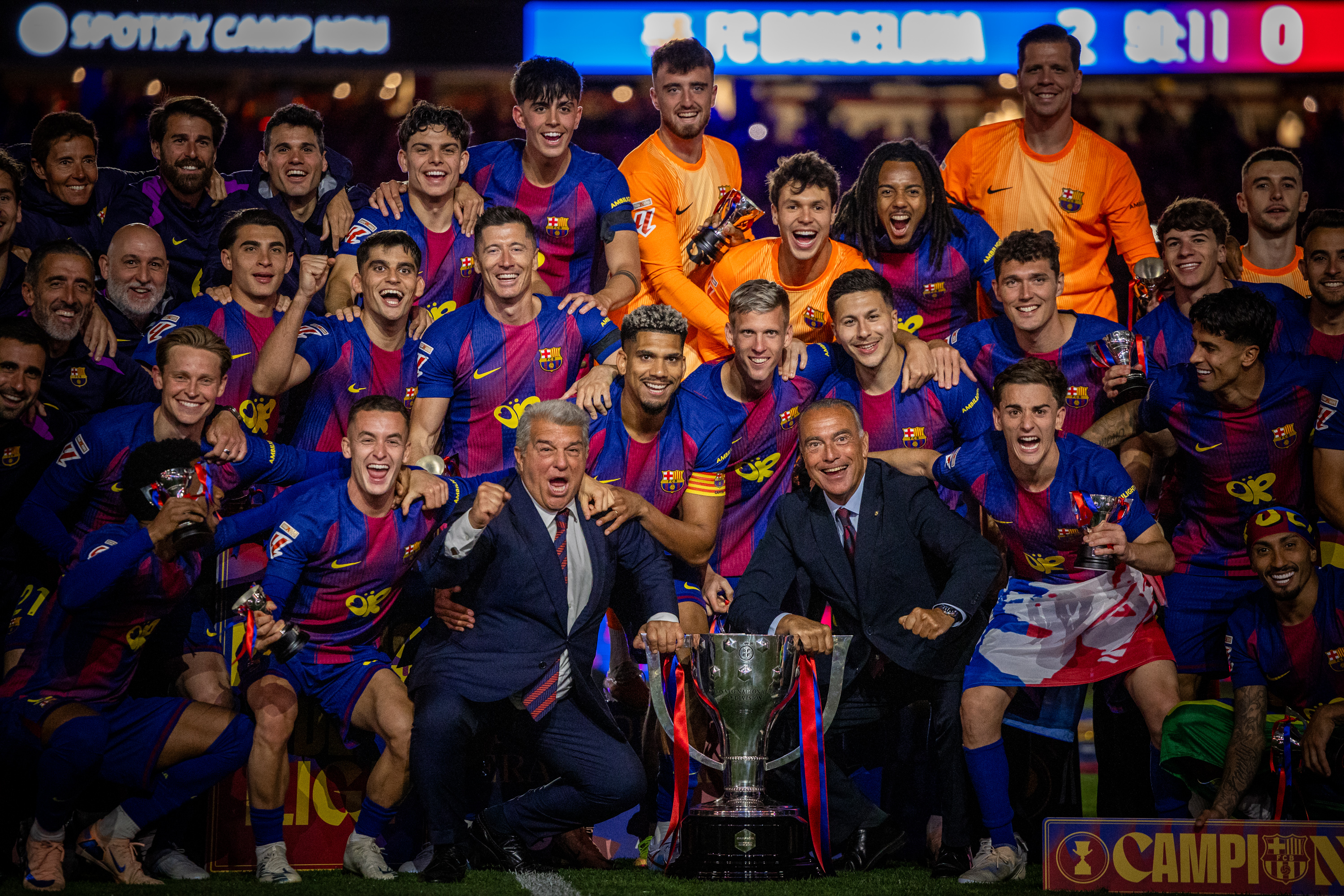
Hansi Flick arrived in 2024 and won the league in his first season, then again in 2025/26, clinching the 29th title in the club's history in the first Clásico at the rebuilt Camp Nou. The recruitment around the academy core has been measured rather than extravagant — Joan García from Espanyol for around €25m is the kind of signing the club now makes, rather than the €100m-plus fees of the late 2010s.
Europe remains the gap. After reaching the semi-finals in 2024/25, Barcelona went out in the quarter-finals in 2025/26, against an Atlético Madrid side that finished 25 points behind them in the league. Domestic dominance, European frustration: the squad is not yet the finished article, and the budget does not yet allow the club to complete it.
The rebuild in six steps
Read it left to right for the sporting story, right to left for the financial one.
- 2021€481m lossMessi leaves
- 2022The leversTV rights, Barça Studios
- 2023Stadium works beginExile to Montjuïc
- 2024–25Flick, league titleVIP seats lever
- Nov 2025Back at Camp NouPartial capacity
- 2026€1.06bnSecond title
Five years from a €481m loss to a billion-euro turnover. The dates on the right depend on the sales on the left: the recovery was financed before it was earned.
What the latest accounts actually show
2025/26, in two columns
The accounts, approved on 19 September 2026 by 88% of the delegates: the club's strongest in years on the headline measures, and still fragile underneath.
What has recovered
What has not
The two columns describe two different things, and both are true. The football business has been repaired: it generates more than it costs, it no longer relies on the transfer market, and wages are back under control. The balance sheet has not been repaired: it carries the stadium, the levers and the losses of the crisis years, and it will for a long time.
The stadium is the real bet
Everything now depends on the Camp Nou. The rebuild, financed with more than €1.2bn of debt, was designed to be the stream that finally closes the gap — a larger, modern stadium with the premium seating, hospitality and non-football events that the old ground could not offer. Analysts expect it to add in the region of €250m a year once complete. The club's own budget for 2026/27 is more cautious, counting on around €60m of additional stadium income as works continue.
That gap between the two figures is the key uncertainty of the next five years. If the stadium delivers at the higher end, the debt becomes serviceable and the levers look like an expensive bridge to a sound business. If it does not, the club will have mortgaged a quarter of its television income and a slice of its best seats for a recovery that the stadium cannot finish. Part of the seats that were supposed to generate that premium revenue have, it should be remembered, already been sold.
The tension worth watching
Every lever solved the problem of one season by creating a cost in all the following ones. For five years that trade-off worked, because the sporting results and the new stadium arrived in time to make the future look larger than what had been sold. The question now is whether Barcelona can grow its revenue fast enough to outrun the share of it that already belongs to someone else. A quarter of its league television income will go to Sixth Street every year until the late 2040s — long after the players who were registered thanks to that sale have retired.
The model, dimension by dimension
A reading, not a measurement. Five blocks is a structural strength, one is a structural weakness.
The fair conclusion is that Barcelona has rebuilt a football club and not yet a balance sheet. The first was achieved with remarkable speed, and much of the credit belongs to an academy that no lever could have bought. The second will take the rest of the decade — and will depend on whether a rebuilt stadium can earn back what the club sold to afford building it.