Start with what it is not
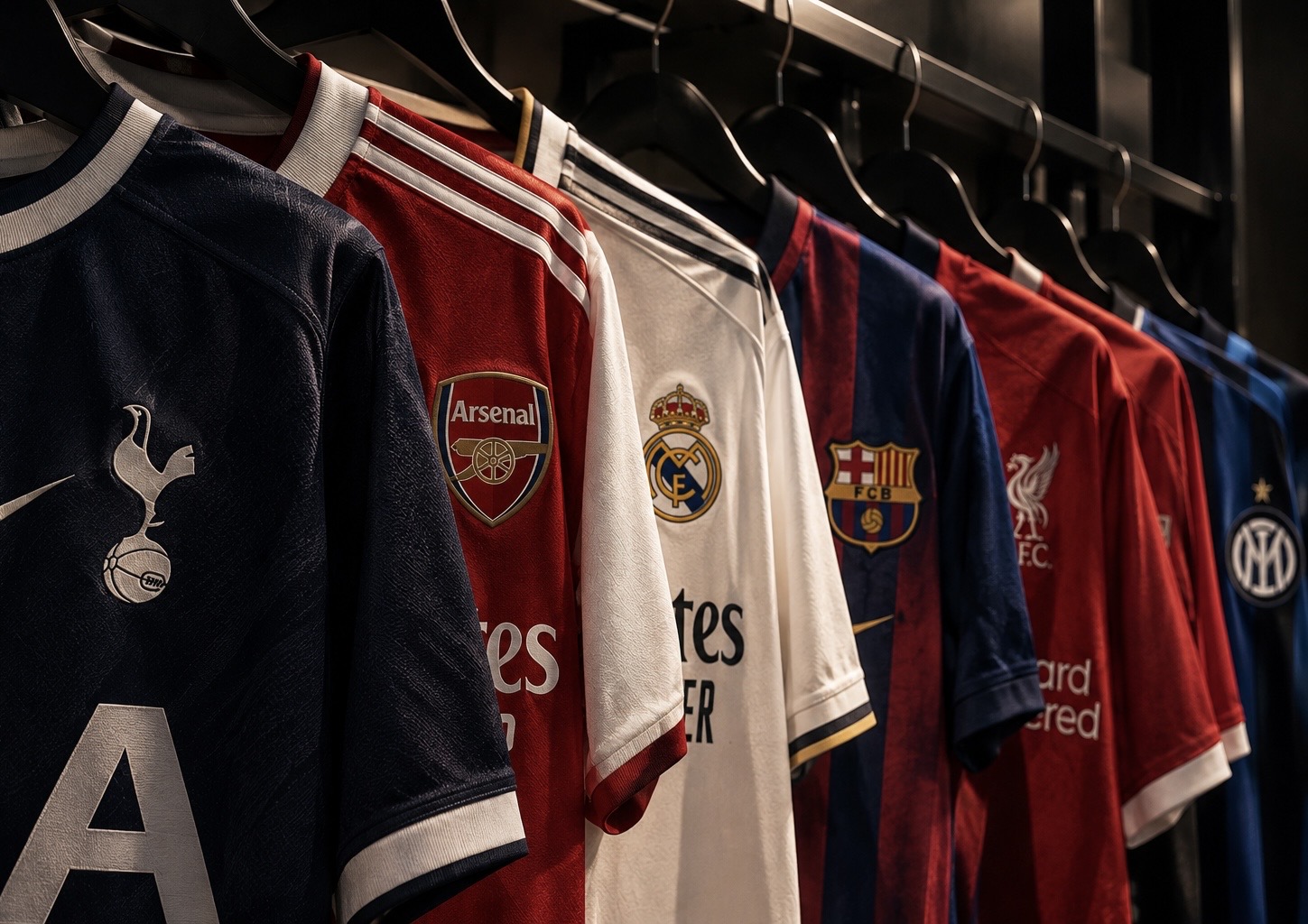
We could reasonably think that all those shirts — worn in every stand, in every school playground, on every street corner of a city — represent the bulk of what a club earns. Could a name and a number sold hundreds of thousands of times a year really be anything other than a pillar of the business?
It could, and it is. A club does not manufacture its own kit, does not distribute it and does not keep the price on the tag. The supplier owns production and most of the margin, and the club receives a royalty on sales. What the club earns reliably from that relationship sits elsewhere: the fixed annual fee its kit supplier pays for the partnership itself, a sponsorship contract negotiated years in advance, whose value does not move because a new signing has become popular. Merchandising is real income. It is one component of one of the three streams, not a foundation.
The pillar, for the overwhelming majority of clubs, is television.
Three streams, and a fourth source of money
The classification below comes from the way clubs report their accounts, and it has become the industry's common language. Matchday covers everything earned on the day itself. Broadcast covers money paid for the right to show the matches. Commercial covers everything else a club can sell using its name.
Three streams, and the order everyone gets wrong
Combined income of the twenty highest-earning clubs in Europe, 2024/25 season.
This ranking holds at the very top, where a handful of global brands have built sponsorship and retail businesses nobody else can match. One tier down it reverses. Player trading appears nowhere here: it is not revenue, and it lands much further down the account.
Across the twenty highest-earning clubs in Europe in 2024/25, commercial income reached €5.3bn, broadcast €4.7bn and matchday €2.4bn. That ranking holds at the very top, where a handful of global brands have built sponsorship and retail businesses nobody else can match. Move one tier down and it reverses: for most clubs in most leagues, broadcast remains the largest single line by some distance.
The fourth source, and where it sits
Selling a player brings in cash, often a lot of it, and it can rescue a season on its own. But it is not operating revenue. What reaches the accounts is a gain on disposal — the fee minus whatever value the player still carried on the balance sheet — and it appears well below the revenue line, close to the bottom of the account. A club can therefore report a healthy final result while its operating performance was poor, which is exactly why regulators examine the two separately. The mechanics are set out in the piece on transfers, and the rest of this article leaves them aside.
Why clubs gamble on Europe
Broadcast income arrives from two sources with opposite characteristics. Domestic rights come from the league and are acquired simply by being in the division: every club receives its share, whatever happens. European money is conditional — it exists only if the club qualifies, and it disappears entirely if it does not. The whole planning cycle of a mid-sized club bends around that second, uncertain half. Qualifying for the Champions League is worth a multiple of the Europa League, which is itself worth a multiple of nothing. Around that money sits everything it drags with it: bigger gates for European nights, sponsorship clauses indexed on participation, and the ability to attract players who want that stage.
So clubs invest ahead of the result. They sign in July for a qualification that will only be decided the following May, betting that European income will cover the transfer spending and the wages committed to secure it. When the bet lands, the model works. When it does not, the club has bought a squad on the strength of revenue that never arrived, and the correction is brutal because wages are contractual while qualification is not.
Worked example — Olympique de Marseille, 2025/26
A club that invested to reach the Champions League and finished outside European qualification altogether.
| Outcome | |
|---|---|
| European qualification | None |
| UEFA distributions | None |
| European gates at the Vélodrome | None |
| Reported deficit for the season | ≈ €105m |
French domestic rights fell in the same year. Two sources of broadcast income contracted at once, against wages agreed the previous summer.
Why the mix matters more than the total
Two clubs can report the same revenue and be in completely different situations. What separates them is the share of income they control, and the share that simply arrives because of where they finished last season.
The same revenue, two different situations
What separates two clubs on identical turnover is the share of income they control, and the share that simply arrives because of where they finished last season.
A broadcast-led club
A commercially-led club
One caveat applies to both columns, and it is easy to miss. Very few clubs are profitable on their operating performance alone. Revenue in this industry is large but wages are larger still: competitive pressure means that almost every additional euro earned is spent on the squad that earned it. Which is why so many clubs only reach a positive result once player sales are added at the bottom of the account — the fourth source of money, doing the work that the three revenue streams could not.
How broadcast money is actually booked
Supporters picture a cheque. The accounts see something slower. A league sells its rights for several seasons at once and the broadcaster pays in instalments, but none of that timing decides when the money becomes revenue. What decides it is delivery: a club earns its share as the fixtures are played.
Cash received before those fixtures have taken place cannot be counted yet. It sits on the balance sheet as deferred income, a liability, and is released into the income statement across the season.
From contract to revenue
Cash and accounting rarely move at the same speed, which is why a club's bank balance in July says very little about its year.
The delayed effect: a bad season has already been paid for at the full rate. What changes is next year's income, against a wage bill already signed.
This produces an effect worth spelling out, because it explains why financial trouble in football always seems to arrive a year late. Take a club relegated, or eliminated from Europe, in May. The season it has just played was paid at the full rate, and that income has already been recognised in the accounts being closed. Nothing looks alarming yet. The loss of income concerns the following season: fewer matches sold, a lower distribution, no European money. And by then the club has already committed the wages and transfer fees it agreed when the money still looked safe.
The sporting failure happens in one year. The financial failure lands in the next.
When the market stops paying
For three decades, the industry planned on a simple assumption: each rights cycle would be worth more than the last. That assumption has broken, and not because supporters stopped watching. Piracy has taken a large share of the paying audience, the calendar has become saturated with competing competitions, and a consolidating broadcast industry now has fewer buyers willing to bid against each other. When two or three bidders become one, an auction stops being an auction.
France went first and hardest. After a failed tender, the league salvaged an arrangement worth roughly €500m a season from DAZN and beIN Sports. It lasted one season. DAZN walked away in the summer of 2025 and the Ligue de Football Professionnel did something no major European league had done: it became its own broadcaster, launching the Ligue 1+ platform with an initial investment of around €165m. Domestic receipts for 2025/26 are estimated between €180m and €220m, against €500m the previous year — a fall of fifty-five to sixty-four percent. The champion of France is expected to collect between €12m and €18m in domestic broadcast money, less than a mid-table Ligue 2 club received a season earlier.
Which is why the leagues turned to private equity
If the auction will not deliver, a league has one other way to raise money against its rights: sell a share of them to an investor. Spain went first, selling a slice of its future audiovisual revenue to CVC for close to €2bn in 2021 under the Impulso programme. France followed in 2022, with CVC injecting €1.5bn into the league's commercial subsidiary. Italy is now in the same conversation: binding offers have been prepared by Carlyle, Bain Capital, Oaktree and Nextalia for a minority stake in a new company housing Serie A's international media rights, overseas sponsorship and betting operations — a business generating roughly €250m a year and valued at three to four billion euros. An earlier attempt, a €1.7bn CVC-led offer in 2020, collapsed when the clubs rebelled.
What a league trades when it sells a share of its rights
The structure is always the same, and it is worth being precise about what is being exchanged.
What the league receives
What the league gives up
Call it what it is: a league securitising its own future income. That is a legitimate financial tool, used across many industries. It is also the clearest possible signal that a league no longer expects the traditional route to fund it comfortably.
England is the partial exception. Its domestic deal for 2025 to 2029 is worth £6.7bn, around £1.67bn a season, the largest sports media agreement ever concluded in the United Kingdom. But the previous cycle already ran at roughly £1.62bn a season: the increase is a few percent, spread over a longer contract. The English domestic market is not booming either — it is flat at a very high level. What separates England is elsewhere, in international rights, which overtook domestic ones for the first time in the 2022 to 2025 cycle at roughly £5.3bn against £5.1bn. Those contracts are sold market by market, territory by territory, and no other European league comes close on that measure. It is also precisely the asset Serie A is now trying to sell a stake in.
What other sports do with the same problem
Football is not the only sport that sells collective rights, and the comparison is instructive — not on the size of the pot, but on what happens to it afterwards.
How other sports divide the same pot
The instructive comparison is not the size of the money. It is what happens to it afterwards.
Shared equally
Weighted by performance
Cricket adds a third model. The Indian Premier League sells five-year cycles — the current one at roughly $6.2bn, about $1.24bn a season — across only seventy-four matches. Measured per match, that puts it second in world sport behind the NFL and ahead of the Premier League, which is a useful corrective to the habit of ranking leagues by total size. A league that plays fewer matches sells each one for more.
The reason American leagues can share equally is structural, not cultural. They are closed: no promotion, no relegation, a hard salary cap, and the same owners next year. Sharing costs them nothing competitively and maximises the value of the product, because a league of close matches sells better than a league of certainties. Formula 1 sits in between, with a cost cap and a dilution fee designed to protect existing teams when a new one arrives.
European football is open. Clubs move between divisions, compete in different European competitions, and generate wildly different audiences. Distribution therefore rewards performance, which compounds existing advantages: the club that finishes first earns most, spends most, and finishes first again. The Premier League is the least unequal of the big European leagues on this measure — and it remains far more unequal than the NFL.
The rules built to stop clubs going under
Put the two halves of this article together and the problem states itself. Income is volatile, wages are contractual, and a league that loses half its television money still has to fulfil every deal its clubs signed the previous summer. Regulators have responded by shifting their attention from losses already made to spending about to be committed.
England polices outcomes. Its Profitability and Sustainability Rules cap the losses a club may accumulate over three rolling seasons, and enforcement now runs through points deductions rather than fines — the first time in the modern era that a financial rule has rewritten a league table.
UEFA polices proportion. Its squad cost ratio limits what a club may spend on wages, transfer amortisation and agent fees to a share of its own revenue. That design has a consequence worth noticing: it is a ratio, not a ceiling. When broadcast income falls, the permitted spend falls with it, automatically and immediately. The rule tightens hardest exactly when clubs are already struggling.
Spain polices in advance. LaLiga sets each club a squad cost limit before the season begins, and a club that exceeds it cannot spend freely again until it is back inside: instead of reinvesting everything it frees up, it may reinvest only a fraction of it. That is the difference behind the shorthand of a club being "at 1:1" or not — and it is why some clubs have been unable to register players they had already signed. Formula 1 reached the same destination by a simpler route, capping what a team may spend outright, which only works because the grid is closed and the number of competitors is fixed.
None of this is watertight, and French football has just supplied the demonstration. The Girondins de Bordeaux, six-time champions of France, went through the mechanism described above more than once: the DNCG examines a forward budget, finds it does not hold, and relegates administratively — whatever the results on the pitch. The club entered receivership, was pushed down the divisions by the regulator rather than by its own results, then gave up professional status altogether and closed a renowned academy. Top flight to the amateur levels in a handful of years, and further since.
The rules caught the club. They did not save it, and by the time they bit, there was little left to protect.